Garage doors are the largest entry point into most homes, and according to the U.S. Department of Justice, roughly 9% of residential burglaries happen through the garage. In Fresno, where property crime rates have historically run above the national average, that statistic carries real weight. If your garage door is old, poorly maintained, or relying on a basic opener from a decade ago, you may be leaving an obvious vulnerability wide open.
The good news is that improving garage door security does not require a full replacement in most cases. A combination of hardware upgrades, smarter habits, and knowing when to call in a professional can dramatically reduce your risk.
Start With an Honest Assessment of What You Have
Before spending money on upgrades, take a close look at what your current setup actually involves.
Ask yourself:
- How old is the garage door opener? Units older than 10 years likely lack rolling code technology, which means a tech-savvy thief could potentially clone your remote signal.
- Does the door have visible damage, warping, or gaps along the frame? These are physical weak points.
- Is there an emergency release cord accessible from outside? On older doors, a thin wire or coat hanger inserted through a gap near the top panel can trigger it.
Starting with this kind of honest audit helps you prioritise. Not every home needs the same solution.
Upgrade Your Opener to a Rolling Code System
One of the highest-impact changes you can make is upgrading to a modern opener with rolling code technology. Unlike fixed-code systems, rolling code openers generate a new access code every time the remote is used. That makes code-grabbing attacks essentially useless.
Brands like LiftMaster and Chamberlain have offered rolling code systems since the mid-1990s, and most current models also include smart home integration, which opens up a whole additional layer of control.
If you are unsure whether your opener uses rolling code technology, check the label on the back of the remote or the opener unit itself. Look for phrases like “Security+” or “Intellicode.” If neither appears, that is a signal worth acting on.
Add a Deadbolt to the Door Between Your Garage and Home
Many homeowners focus entirely on the garage door itself and forget about the interior door connecting the garage to the living space. This door is often hollow-core and secured with a basic knob lock, which provides very little resistance.
Fitting a solid-core door with a proper deadbolt here is one of the most cost-effective security upgrades available. Even if someone gets into the garage, they hit a second barrier before reaching your home.
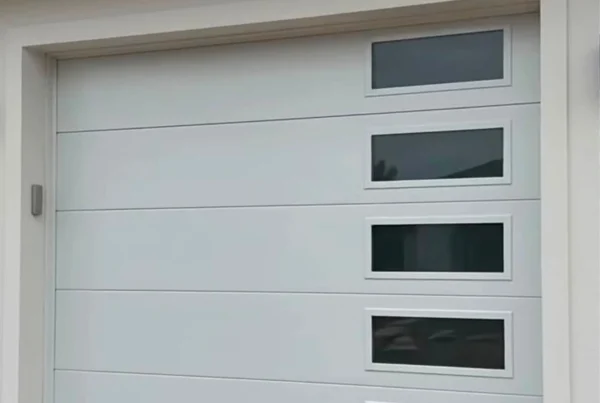
While you are at it, check whether there are any windows in the garage door panels. If so, consider frosted or tinted glass that limits visibility into the space. Opportunists often scope out garages to see what is worth taking before they act.
Secure the Emergency Release
The emergency release cord is a necessary safety feature, but it can also be exploited. A common break-in technique involves threading a hooked tool through the top weatherstripping gap and pulling the release lever.
There are two practical fixes:
- Zip tie the release cord to the trolley carriage. This does not disable the emergency release entirely but makes it significantly harder to trigger from outside. The zip tie will break under manual force during a genuine emergency, so the safety function remains intact.
- Install an emergency release shield. These are low-cost plastic covers that prevent a hook from reaching the lever. They attach directly to the cord and add meaningful resistance without modifying the mechanism itself.
Consider a Garage Door Monitor or Smart Sensor
Leaving the garage door open accidentally is one of the most common and preventable security lapses. A survey by Chamberlain found that a significant percentage of homeowners reported regularly forgetting to close their garage door after leaving.
Smart garage door monitors solve this problem cleanly. Devices like the Chamberlain MyQ or the Meross Smart Garage Door Opener connect to your home Wi-Fi and allow you to check door status, receive open alerts, and close the door remotely from your phone. Some models integrate with Google Home, Amazon Alexa, and Apple HomeKit.
This kind of connectivity is especially useful for Fresno homeowners who commute or travel regularly.
Reinforce the Door Frame and Track
Physical reinforcement is often overlooked, but the frame and tracks are just as important as the door itself. A door that is dented, bent, or mounted in a weakened frame can be forced open more easily, even if the lock mechanism is solid.
Key reinforcement steps include:
- Replacing lightweight or worn weatherstripping along all four sides to eliminate gaps
- Checking that the door tracks are free of debris and properly aligned, since misaligned tracks put stress on the motor and create uneven gaps
- Installing a slide lock or bar lock on the inside of the door for periods when the garage will not be used for an extended time, such as vacations
If the frame itself shows rot, rust, or significant wear, that is a conversation for a qualified technician rather than a DIY patch job.
Lighting, Cameras, and the Deterrence Layer
Physical security works best when it is supported by a visible deterrence layer. Motion-activated lighting around the garage entry is one of the most effective and affordable deterrents available. Studies from the Crime Prevention Research Center suggest that visible security measures reduce opportunistic break-ins substantially, even without an alarm.
A security camera pointed at the garage door adds another layer. Position it high enough that it cannot be easily disabled, and make sure the field of view covers both the door and the driveway approach. Visible cameras are often enough to make someone move on.
If you use a keypad on the outside of the garage, change the access code periodically and avoid using obvious combinations like birth years or repeating numbers.
Know When to Call a Professional
Some security upgrades are genuinely DIY-friendly. Others need a trained technician to do properly, and attempting them without the right knowledge can create new problems or void warranties.
Signs that a professional garage door service visit is warranted include:
- Unusual grinding, scraping, or hesitation when the door opens or closes
- Visible cable fraying or spring damage (springs are under extreme tension and dangerous to handle without training)
- A door that does not sit flush with the ground or frame when closed
- An opener that resets or malfunctions inconsistently
Scheduling a professional inspection annually is standard practice for homeowners who want to stay ahead of issues rather than react to them. A technician can catch worn hardware, alignment problems, and security vulnerabilities that are easy to miss during a casual look.
For Fresno homeowners looking for reliable support, A Plus Garage Door provides local expertise on both repairs and security-focused upgrades that suit the region’s climate and housing styles.
Key Takeaways
- Roll code openers are a significant security upgrade over older fixed-code systems and should be a priority for anyone with a unit older than 10 years.
- The interior door between your garage and home is often the weakest link; a solid-core door with a deadbolt addresses that gap directly.
- Securing the emergency release cord with a zip tie or shield prevents one of the most common forced-entry techniques.
- Smart monitors and motion-activated lighting work together to create a deterrence layer that passive hardware alone cannot provide.
- Annual inspections by a qualified garage door service technician catch mechanical vulnerabilities before they become security risks.
Frequently Asked Questions
How often should I have my garage door professionally inspected? Once a year is the general recommendation for most residential garage doors. If the door sees heavy daily use or shows any signs of wear, twice a year is more appropriate. A professional inspection covers springs, cables, rollers, the opener mechanism, and the overall balance of the door.
Can I improve garage door security without replacing the whole door? Yes, in most cases. Upgrading the opener, securing the emergency release, reinforcing the interior door, and adding smart monitoring devices are all meaningful improvements that do not require a full replacement. Replacement only becomes necessary when the door itself is structurally compromised or too old to support modern hardware.
What is rolling code technology and why does it matter? Rolling code technology generates a new encrypted signal each time you use your garage remote. Older fixed-code systems broadcast the same signal every time, which makes them vulnerable to signal interception. Modern openers with rolling code make that kind of attack effectively useless.
Are smart garage door openers difficult to install? Add-on smart controllers like the Chamberlain MyQ can be retrofitted to most existing openers in under an hour without professional installation. Built-in smart openers that replace the full unit are more involved and typically benefit from professional setup to ensure compatibility and proper configuration.
Is it worth installing a security camera specifically for the garage? A camera positioned at the garage entry serves two purposes: deterrence and documentation. Visible cameras discourage opportunistic crime, and recorded footage is valuable for insurance claims or police reports if something does occur. Given the relatively low cost of entry-level security cameras, the investment is generally worth it for most homeowners.
Take the Next Step
Improving garage door security is mostly about stacking small, practical measures rather than chasing one perfect solution. Better hardware, smarter habits, and occasional professional oversight combine to make a meaningful difference.
If you have questions about what upgrades make sense for your specific door and setup, or you need a thorough inspection before making any changes, feel free to contact us to get guidance from someone who knows Fresno garages firsthand.