Garage door material gets chosen from a showroom photo more often than from any analysis of the climate it has to survive. In Fresno that is a costly habit, because the Central Valley combination of triple-digit summers, relentless ultraviolet exposure, and very low humidity is genuinely hard on some materials and barely noticed by others. The door that looks best in a brochure is not always the one still looking good in year eight, and the decision affects more than appearance once you factor in what a hot garage does to the rest of the house. Choosing well starts with understanding what the climate actually does to each garage door option.
Short Answer
For most Fresno homes, insulated steel is the best balance of cost, durability, and heat performance. Wood looks the best and demands the most maintenance in this climate, because dry heat and UV work against it constantly. Aluminum with glass suits modern architecture and wide openings. Wood composite gives the wood appearance without the refinishing schedule. More important than the material itself is the construction: an insulated door with a polyurethane core will outperform a better-looking uninsulated one on comfort, energy, and noise.
What Fresno Conditions Actually Do to a Garage Door
Four local factors matter, and they do not affect every material equally.
Heat
Summer temperatures regularly push past 100 degrees, and an uninsulated garage becomes an oven that radiates into whatever is next to it. If your garage shares a wall with living space, sits below a bedroom, or doubles as a workshop or gym, that heat is a daily cost rather than an abstraction.
Ultraviolet exposure
Sustained direct sun fades finishes, chalks paint, and degrades some plastics and composites. South and west facing doors take the worst of it, which is worth checking before selecting a color or material.
Low humidity
Dry air pulls moisture out of wood. Boards shrink, joints open, and panels check and crack. This is the single biggest reason wood behaves differently here than in a coastal or humid climate.
Dust
Central Valley agricultural and road dust accumulates on tracks, rollers, hinges, and photo eye lenses, and it affects every door regardless of material.
Garage Door Material Options, Compared
| Material | Fresno heat & UV | Maintenance | Best suited to |
|---|---|---|---|
| Steel | Holds up well – resists warping, keeps paint and powder-coated finishes under sun | Low – washing and hardware attention | Most homes; full range of insulation options |
| Aluminum & glass | Admits heat – glazing choice matters, lower insulation value | Low – does not rust, marks more easily than steel | Contemporary architecture, very wide openings |
| Wood | Hardest hit – dry heat and UV work on it continuously | High – refinishing on a schedule | Homes where architecture calls for it and upkeep is realistic |
| Wood composite | Stable – far better dimensional stability than solid wood in dry air | Low – no refinishing schedule | Homeowners who want the wood look without the upkeep |
| Fiberglass & vinyl | Finish can fade – fiberglass may turn brittle under years of intense sun | Low – dent resistant, limited colors | Low-maintenance priority where finish longevity is checked first |
Summary of the sections below. The right choice for a specific home also depends on how the door is constructed, covered under Insulation Matters More Than Material.
Steel
The most common choice, and for good reason. Steel resists warping, holds paint and powder-coated finishes well under sun exposure, and needs very little maintenance beyond washing and hardware attention.
Gauge is the specification to ask about. A lower gauge number means thicker steel and better dent resistance, and the difference between a light builder-grade door and a heavier one is noticeable the first time something hits it. Steel dents rather than cracks, which is usually the preferable failure mode, and individual panels can often be replaced.
Steel is also available across the full range of insulation constructions, which matters more in this climate than the skin material does.
Aluminum and full-view glass
Aluminum is light and does not rust, which makes it well suited to very wide openings where weight is a real design constraint. The tradeoff is dent resistance, since aluminum marks more easily than steel of comparable thickness.
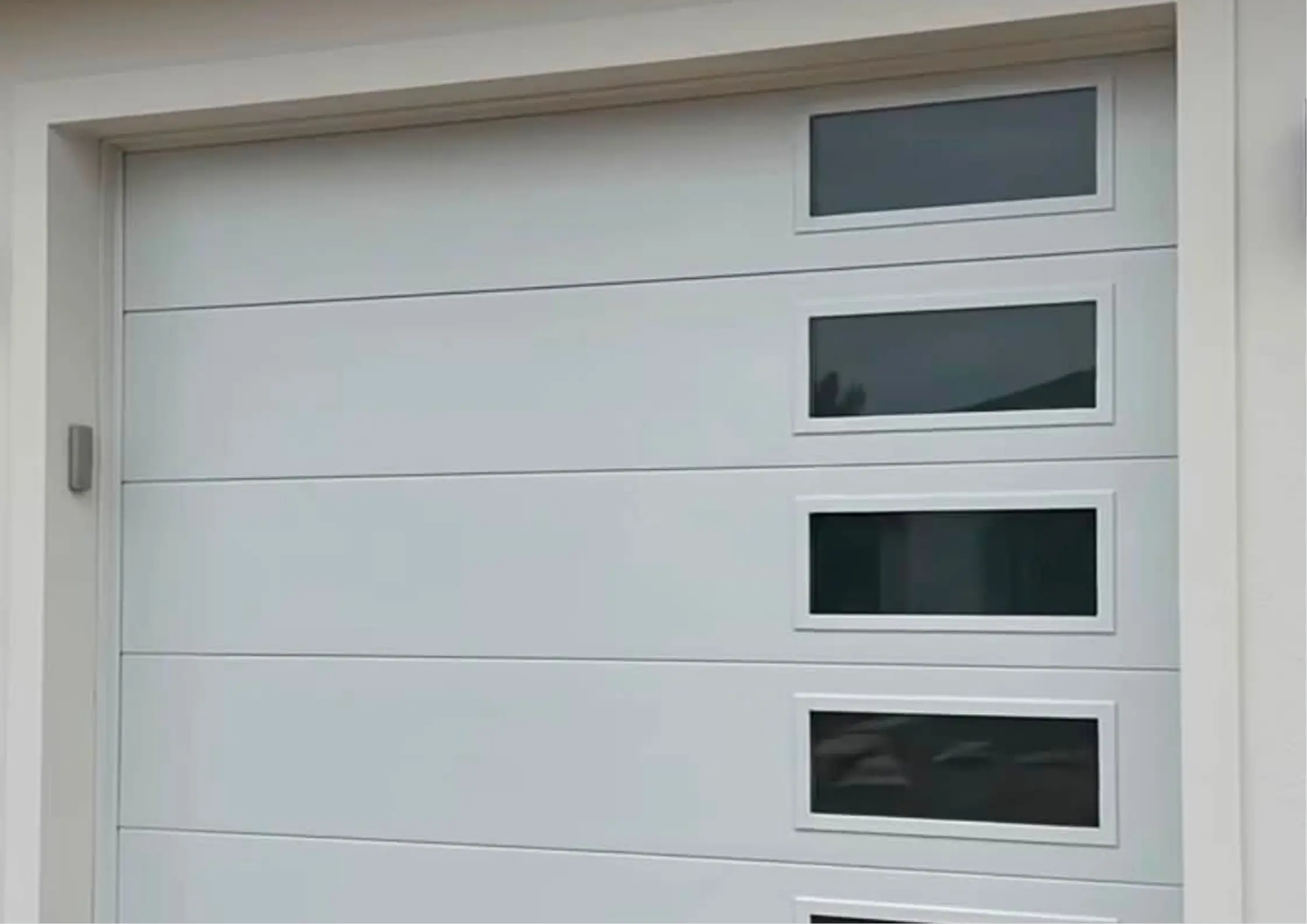
The full-view aluminum and glass doors that suit contemporary architecture fall into this category. They look excellent and they let a lot of light into the garage. They also let in a lot of heat, so glazing choice matters considerably here, and insulation values are generally lower than a solid insulated door.
Wood
Nothing else looks like real wood, and on the right house it is worth the trouble. Understand what the trouble is.
Fresno’s dry heat and UV exposure work on wood continuously. Refinishing is a scheduled obligation rather than an occasional task, and a neglected wood door deteriorates visibly. Wood is also heavy, which affects spring sizing and opener selection, and it is the most expensive option both to buy and to maintain.
It remains the right answer for certain homes, particularly where architecture or a neighborhood aesthetic calls for it, and where the owner is realistic about upkeep.
Wood composite and faux wood
Engineered composite and steel doors with realistic wood-grain finishes solve the appearance problem without the refinishing schedule. Dimensional stability is far better than solid wood in dry conditions, and the better products are convincing from the street.
For Fresno homeowners who want the wood look, this is usually the more practical path, and it is where a lot of the market has moved.
Fiberglass and vinyl
Both resist dents and require little maintenance. Both have limitations worth knowing here.
Fiberglass can fade and become brittle under years of intense sun, and color options are more limited. Vinyl is durable and low maintenance but also limited in color, and darker finishes on either material absorb more heat.
Neither is a poor choice, but in a high-UV climate, longevity of the finish deserves specific attention before committing.
Insulation Matters More Than Material
Key Point
If you take one thing from this, take this. In Fresno, how the door is built matters more than what its outer skin is made of.
Doors come in three broad constructions.
Single layer
A bare skin with no insulation, the least expensive and the worst performer.
Double layer
Adds insulation behind the skin.
Triple layer
Sometimes described as sandwich construction, places insulation between two skins, producing the highest insulating value, the most rigidity, and the quietest operation.
Core material matters too. Polyurethane, which is foamed in place and bonds to the skins, generally outperforms sheet polystyrene of comparable thickness and adds structural stiffness at the same time.
The practical result is that an insulated steel door will keep an attached garage meaningfully cooler than an uninsulated one, reduce the heat load transferring into adjacent rooms, and run more quietly. For any home where the garage touches conditioned space, that upgrade usually delivers more day-to-day value than the material choice does.
Color deserves a mention alongside it. Dark finishes absorb more heat than light ones, which on a west-facing door in July is not a trivial difference.
Weight, Springs, and Your Opener
Material choice changes the weight of the door, and weight determines what has to be underneath it.
Torsion springs are sized to balance a specific door weight. Replacing a light uninsulated door with a heavier insulated or wood door without addressing the spring system leaves the door improperly balanced, which strains the opener, accelerates wear, and creates a safety issue.
Get It in the Quote
Any spring work associated with a new door should be part of the quote rather than a surprise afterward.
The opener needs the same consideration. A unit sized for a light door will struggle with a substantially heavier one, and a door that is properly balanced puts far less demand on the opener than one that is not.
Matching the Material to Your Situation
- Attached garage next to living space. Prioritize insulation. Insulated steel, double or triple layer, polyurethane core.
- Detached garage used for storage. Insulation matters less. Steel at a sensible gauge is usually the value choice.
- Garage used as a workshop or gym. Insulation is the whole decision. Triple layer construction.
- Contemporary architecture. Aluminum and glass, with attention to glazing and expected heat gain.
- Traditional or custom home. Wood if you will maintain it, wood composite if you would rather not.
- Wide double or oversized opening. Weight becomes a design factor, which favors aluminum or lighter steel with correctly sized springs.
- Rental or resale within a couple of years. Steel, mid-gauge, insulated. Broad appeal and predictable cost.
Key Takeaways
- Insulated steel suits the majority of Fresno homes on cost, durability, and heat performance.
- How the door is constructed matters more here than the outer material.
- Triple layer construction with a polyurethane core gives the best insulation, rigidity, and quiet operation.
- Low humidity is why wood needs more upkeep in Fresno than in coastal climates.
- Wood composite delivers the wood appearance without the refinishing schedule.
- Full-view aluminum and glass looks excellent but admits substantial heat.
- Dark finishes absorb more heat, which matters on sun-exposed elevations.
- Changing door weight requires matching spring sizing and confirming opener capacity.
Frequently Asked Questions
Is an insulated garage door worth it in Fresno?
For an attached garage, or one below or beside living space, generally yes. It reduces heat transfer into the house during summer, makes the garage usable, and cuts operating noise. For a detached storage garage the case is weaker.
Will a wood garage door survive Fresno summers?
Yes, with maintenance. Dry heat and UV exposure mean refinishing on a schedule rather than when it looks tired. If that commitment is unrealistic, wood composite gives a similar appearance with far less upkeep.
What does gauge mean on a steel door?
It describes steel thickness, and a lower number means thicker material. Thicker steel resists dents better and generally lasts longer, which is why builder-grade doors and premium doors can look similar and perform differently.
Does the color of the door affect how hot my garage gets?
Yes. Darker finishes absorb more solar heat than lighter ones. On a west-facing door taking full afternoon sun, that difference is noticeable.
Do I need new springs when I replace my door?
If the new door weighs differently than the old one, yes. Springs are sized to balance a specific weight, and reusing springs matched to a lighter door leaves the system unbalanced and hard on the opener.
Which material needs the least maintenance?
Steel, vinyl, and fiberglass all require minimal upkeep beyond cleaning and hardware attention. Wood requires the most. All doors, regardless of material, benefit from keeping Central Valley dust off the tracks and sensors.
Conclusion
The best garage door material for a Fresno home is usually insulated steel, not because it is the most attractive option but because it holds up to heat and sun with very little asked of the owner. Where appearance drives the decision, wood composite and full-view aluminum both have a real place. What should not be treated as optional is the insulation, because in this climate the construction of the door affects daily comfort more than the finish on the outside of it.
A Plus Garage Doors installs, replaces, and services residential and commercial garage doors throughout Fresno and the surrounding Central Valley. If you are weighing materials for a replacement or planning a new installation, reach out today to talk through what fits your home and how it is used.