A commercial garage door and a residential one perform the same basic function, which is why property owners in Fresno sometimes assume the difference comes down to size. It does not. The gap between them is engineering, and it starts with how many times per day the door is expected to open. Getting that wrong is the most expensive mistake in this category, because a residential door installed on a business fails early and a business ends up paying for commercial garage door repair on equipment that was never rated for the work.
The differences run through construction, springs, operators, safety requirements, and how often each needs service.
SHORT ANSWER
The defining difference is duty cycle. Residential doors are built for a handful of cycles per day, while commercial doors are engineered for continuous use, sometimes hundreds of cycles daily. That drives everything else: heavier construction, cycle-rated springs, industrial operators with different control types, additional safety requirements, and far more frequent maintenance. Size is a symptom of those choices, not the reason for them.
The Core Difference Is Duty Cycle
Duty cycle means how many complete open and close sequences a door is designed to perform over its life. A typical household opens its garage door a few times a day. A warehouse, a service bay, or a distribution facility may cycle a door dozens or hundreds of times in a single shift.
Every component is specified against that number. Residential hardware meeting its rating in a light-use home will reach the same rating in a matter of months on a commercial property. The door does not fail because it was poorly made. It fails because it was asked to do a different job than the one it was built for.
Construction and Door Types
Residential doors
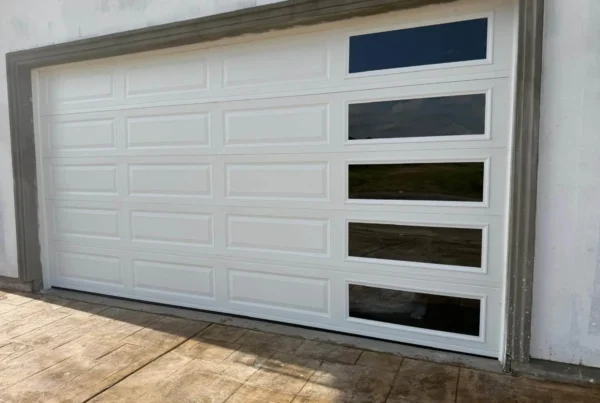
Residential doors are almost always sectional, made of steel panels with polystyrene or polyurethane insulation, and finished for appearance. Curb appeal is a real design constraint, which is why panel styles, window inserts, and finishes matter as much as performance. Weight is kept manageable because the opener and springs are sized accordingly.
Commercial doors
Commercial applications use several distinct door types depending on the building.
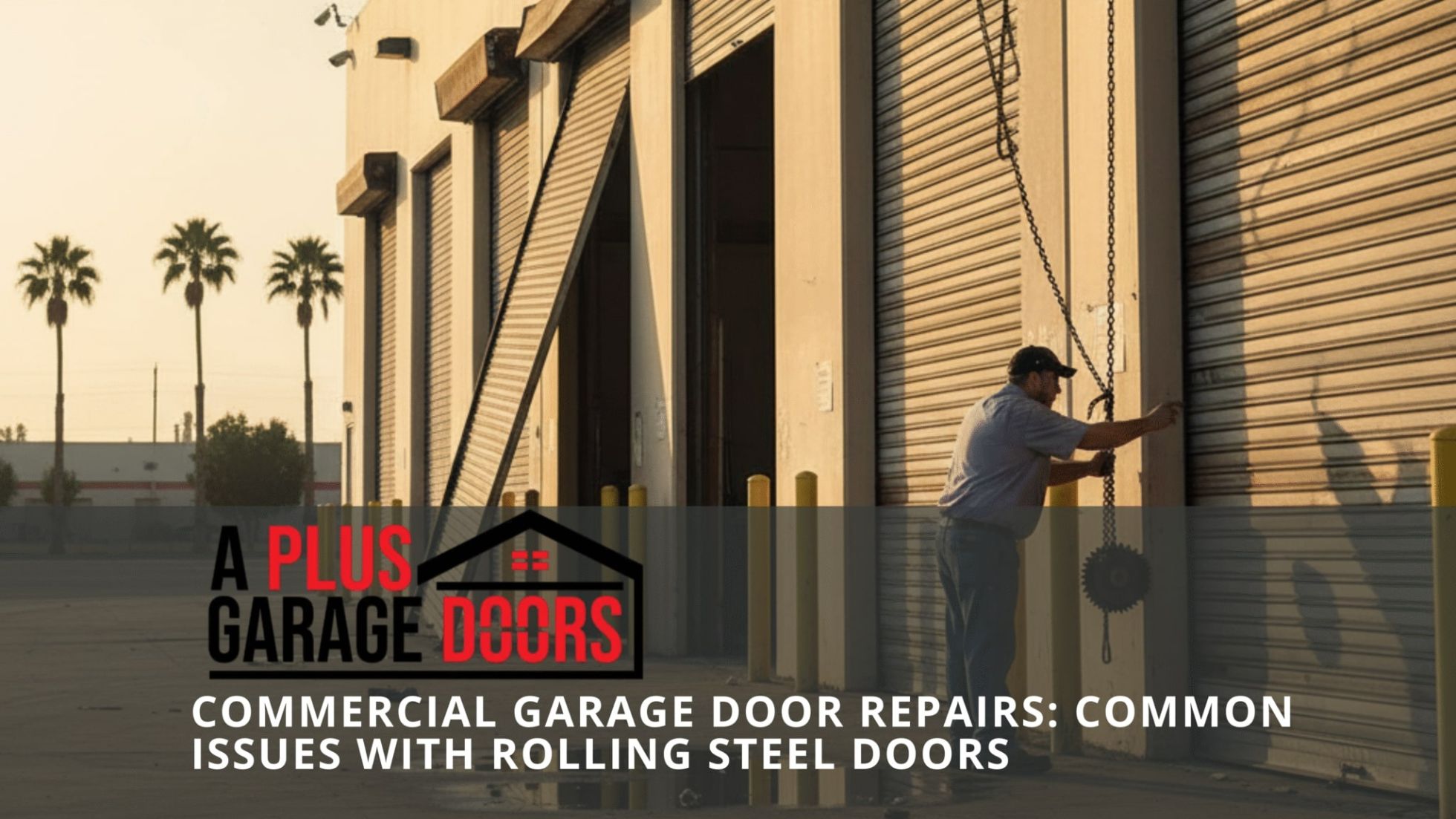
- Rolling steel doors. Interlocking slats that coil above the opening, common where headroom is limited and durability matters more than appearance.
- Heavy-duty sectional doors. Similar in concept to residential sectionals but built with thicker gauge steel and reinforced hardware.
- Full-view aluminum doors. Glass and aluminum, used on showrooms, service bays, and restaurants where visibility is the point.
- High-speed doors. Built to open and close rapidly, used where traffic volume or temperature separation demands it.
- Fire-rated doors. Required at specific openings by building code, and carrying inspection obligations that ordinary doors do not.
Springs, Hardware, and Cycle Ratings
Springs do the actual lifting. The opener only guides the door and holds it in position, which is why spring failure is the most common serious problem on any door.
Torsion springs carry a cycle rating, and standard residential springs are typically rated around ten thousand cycles. In a home opening the door four times a day, that translates to years of service. On a commercial door cycling fifty times a day, the same spring is consumed in months.
Commercial installations use high-cycle springs rated substantially higher, along with heavier tracks, thicker rollers with sealed bearings, and reinforced hinges. When a business experiences repeated garage door spring repair on the same door, undersized springs for the actual usage volume are usually the cause rather than bad luck.
Commercial Garage Door Openers, Controls, and Power
Residential openers are trolley units, chain or belt driven, mounted on the ceiling and sized modestly. They are designed for intermittent use with cooling time between cycles.
Commercial operators differ in several ways. Jackshaft and hoist operators mount beside or above the opening rather than on a ceiling rail. Motors are built for continuous duty. Larger installations may run on three-phase power rather than standard household current. Control types also vary by application, with some doors using momentary contact controls and others requiring constant pressure operation, where the door only moves while someone holds the button.
That control distinction is not cosmetic. It is determined by the door type, the safety devices installed, and the code requirements for the opening, which is why commercial garage door opener installation is specified rather than selected off a shelf.
Safety Requirements and Code Obligations
Residential doors have been required to include external entrapment protection since federal rules took effect in the early 1990s, which is why every modern home door has photo eye sensors near the floor and a reversing mechanism.
Commercial requirements go further in specific cases. Industry safety standards were revised to require monitored entrapment protection on commercial operators, meaning the operator verifies its safety devices are functioning rather than simply accepting a signal. Fire-rated doors carry separate obligations entirely, including periodic drop testing to confirm the door will close properly during a fire event, with documentation retained for inspectors.
For a business, these are compliance matters rather than preferences. An inspector, an insurer, or a liability claim can all turn on whether the required testing was performed and recorded.
Maintenance and What Fresno Conditions Add
Residential doors do well with annual service. Commercial doors need far more, often quarterly or monthly depending on volume, because components wear proportionally to use and a failure stops the business rather than inconveniencing a household.
Central Valley conditions add their own load to both. Summer heat thins lubricants and accelerates wear on rollers and bearings, while agricultural and roadway dust accumulates on tracks, hinges, and photo eye lenses. Dust on a sensor lens produces intermittent reversing that looks like an electronics fault and is often just a cleaning issue. Regular garage door service catches those conditions before they become failures, and the interval matters more here than in milder climates.
Choosing Correctly for Small Business and Mixed-Use Properties
The hardest cases are the in-between ones. A detached shop, a converted garage used commercially, a live-work unit, or a small business operating out of a residential-scale building all raise the same question.
Base the decision on usage rather than on the building’s appearance or its zoning label. A few practical guides:
- Count actual daily cycles over a normal week, not an estimate.
- Consider what a failure costs. If a stuck door halts revenue, specify for reliability rather than for price.
- Account for what passes through the opening. Vehicle weight, forklifts, and clearance requirements affect door and opener selection.
- Check whether the opening carries a fire rating or other code obligation before selecting a door.
- Verify insurance and lease requirements, since commercial leases frequently assign maintenance responsibility and specify standards.
A residential-style door on a lightly used commercial building can be entirely appropriate. The failures happen when volume is underestimated.
Key Takeaways
- Duty cycle, not size, is the fundamental difference between commercial and residential doors.
- Standard residential springs are rated for roughly ten thousand cycles, which commercial usage consumes quickly.
- Commercial operators are continuous duty, mount differently, and may require three-phase power.
- Control type on a commercial door is determined by code and safety devices, not preference.
- Fire-rated doors carry testing and documentation obligations that ordinary doors do not.
- Fresno heat and Central Valley dust shorten service intervals for both door types.
- Specify by actual cycle count and cost of downtime rather than by building appearance.
Frequently Asked Questions
Can a residential garage door be used on a commercial building?
Sometimes, when usage is genuinely light and the opening carries no code requirement. The risk is underestimating volume, since residential hardware wears out quickly under commercial cycling and the replacement cost exceeds what specifying correctly would have cost initially.
Why do commercial doors cost more?
Heavier gauge materials, high-cycle springs, reinforced hardware, continuous-duty operators, and additional safety devices. The cost difference reflects components engineered for a workload that residential parts are not built to handle.
How often should a commercial garage door be serviced?
More frequently than residential, with the interval set by cycle volume. High-traffic openings may warrant monthly attention, while lower-volume commercial doors may do well quarterly. Fire-rated doors carry their own required testing schedule.
What is a high-cycle spring?
A torsion spring manufactured to withstand substantially more open and close cycles than a standard spring, achieved through different wire sizing and dimensions. It costs more initially and lasts far longer under heavy use.
Does a commercial door need three-phase power?
Not always. Many commercial operators run on standard single-phase power. Larger doors and higher-volume applications may require three-phase, which is determined during specification rather than assumed.
My commercial door reverses randomly. What causes that?
Most often obstructed or misaligned photo eyes, and in the Fresno area dust accumulation on the lenses is a frequent culprit. Other causes include track obstructions, worn rollers creating binding, or a safety device signaling a fault, so a door doing this should be inspected rather than repeatedly reset.
Conclusion
The commercial garage door versus residential question resolves on how hard the door works. Light household use calls for one set of components, continuous business use calls for another, and the buildings they sit on matter far less than the cycles they perform. Specifying against real usage costs more upfront and less over the life of the door.
A Plus Garage Doors installs, repairs, and maintains both commercial and residential garage doors for property owners throughout Fresno and the surrounding Central Valley communities. If you are unsure whether your building needs commercial-grade equipment or your current door is failing sooner than it should, reach out today to request service.